

Goals and Retirement Simulation, Now in Wealthfolio
A new save-up simulator for everyday goals and a retirement & FIRE simulator. A step toward Wealthfolio being your wealth companion, not just a tracker.
Wealthfolio started as a tracker, a clean place to see your accounts and holdings, kept locally and out of the way. That part isn’t going anywhere. But tracking only answers half the question. The other half is the one most people actually care about: am I on track, and toward what?
This release is a step toward Wealthfolio being a real wealth companion rather than just a tracker. Two new tools land together:
- Retirement & FIRE Simulator for the longer arc, with both Traditional and FIRE modes.
- Save-Up Simulator for everyday goals like a house deposit, a car, an emergency fund, or any target with a date.
Both run on the same data you’ve already been tracking, and both are local-first like everything else in the app.
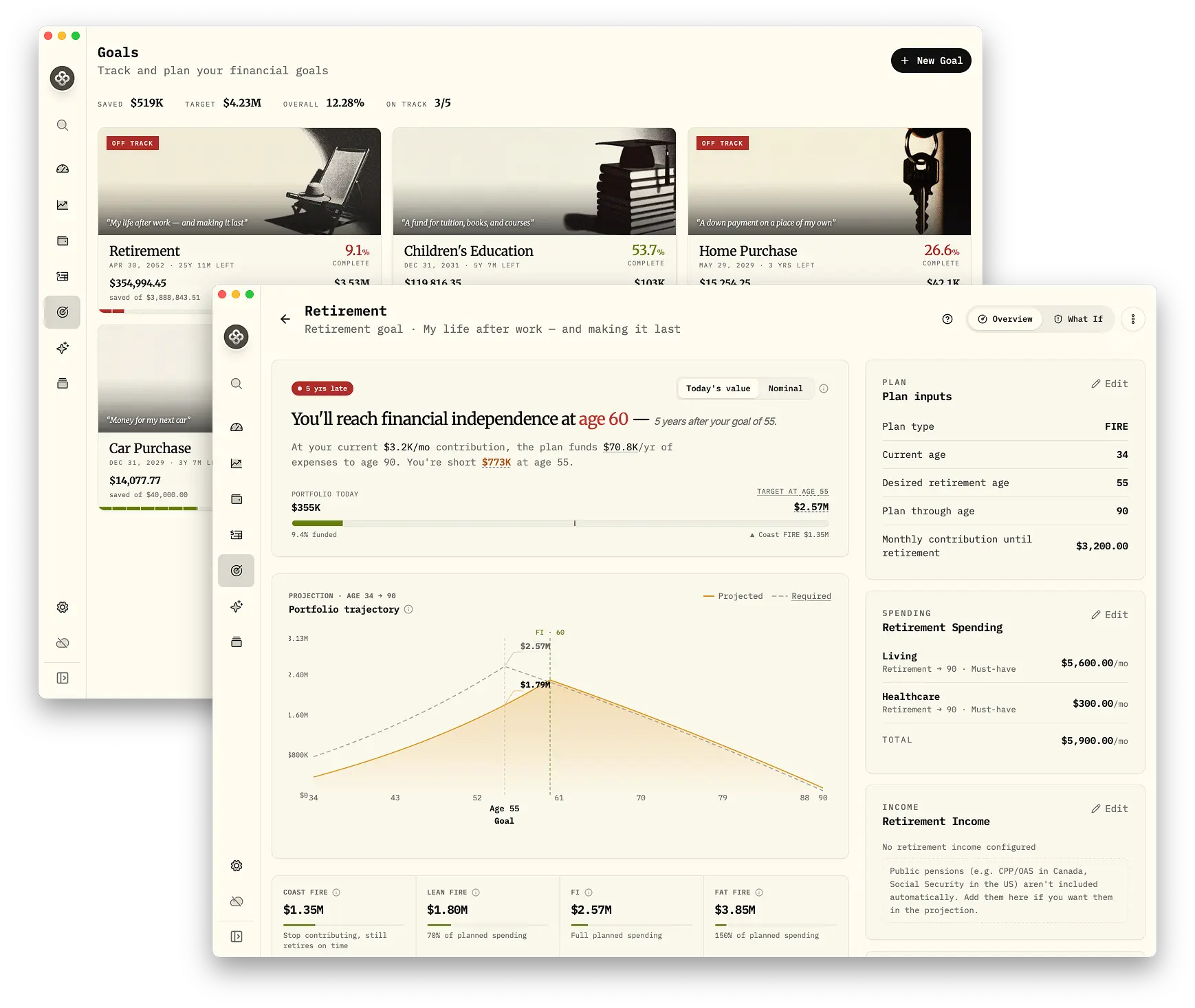
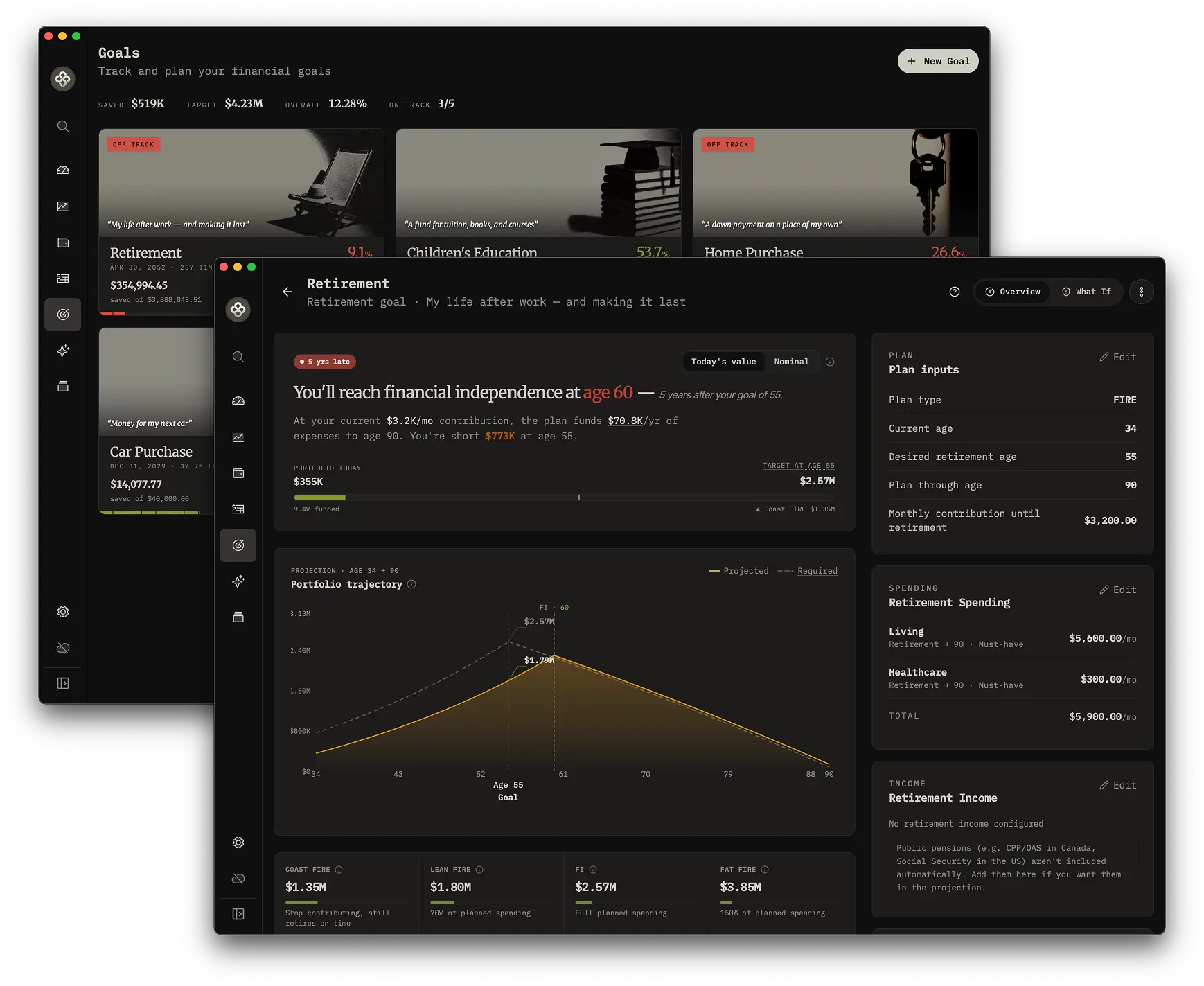
Retirement & FIRE Simulator
Retirement is the one financial question that almost every online calculator answers in a single number. You need $1.6M. Good luck. That answer isn’t very useful, because it doesn’t tell you what assumptions it depends on or how fragile they are.
The new retirement simulator walks your portfolio year by year, not as a calculator that spits out one figure but as a model you can poke at. You enter where you are today, what you spend, what you’ll spend in retirement, the income streams you expect (pension, social security, DC funds), your tax buckets, and your assumed returns. The engine then runs through accumulation, the moment you stop working, and three decades of withdrawals, taxes, and inflation.
It supports two modes:
- Traditional: “I want to retire at 65, am I funded?”
- FIRE: “When do I actually become financially independent?”
Same engine, just a different question.
The Risk Lab then does what a single number can’t:
- Monte Carlo runs the same plan 5,000 times under randomised return paths and reports a success rate plus percentile bands.
- Sensitivity sweeps a single input (return, contribution, retirement age) so you can see which assumptions actually move the answer.
- Sequence-of-returns stresses the early retirement years, where a market drop hurts the most.
The point isn’t to give you certainty. There isn’t any. The point is to let you see your own assumptions, change them, and watch the answer move.
Save-Up Simulator
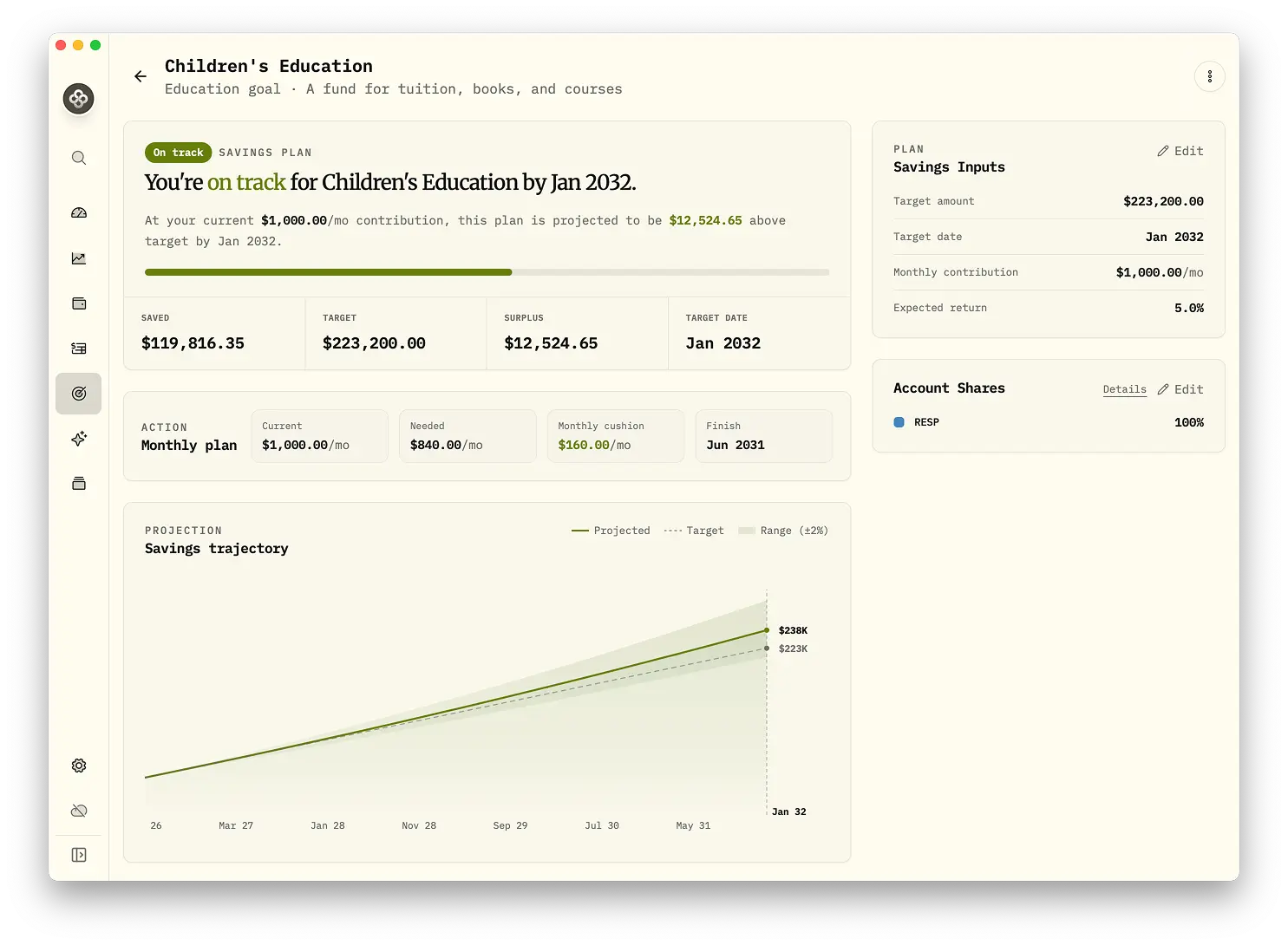
A goal used to be a target and a percentage allocation in Wealthfolio. That worked, but it didn’t tell you whether you were going to make it in time. The save-up engine fixes that.
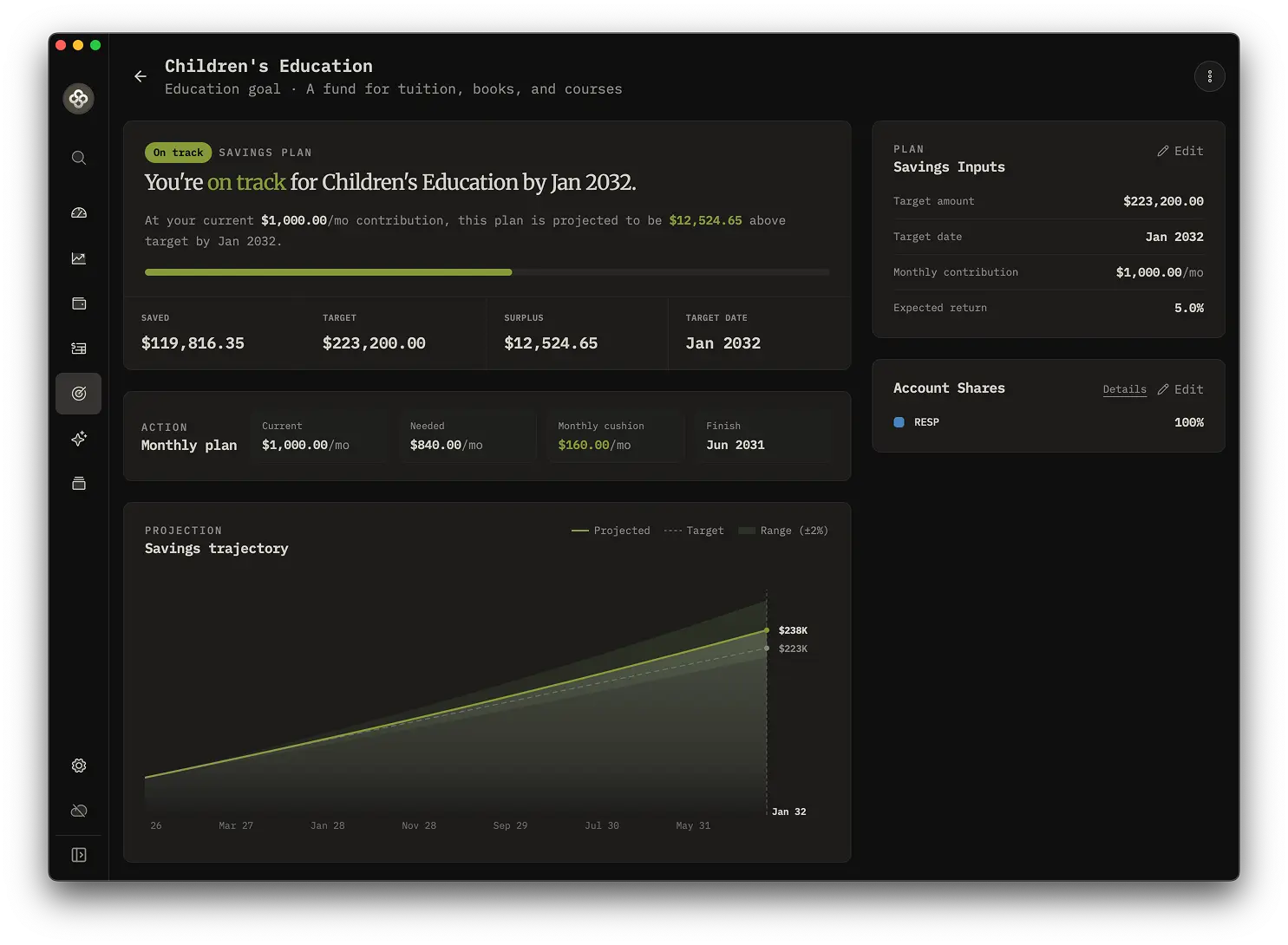
For each goal, the simulator now projects your balance forward year by year, plots a milestone glide path against the target date, and labels the goal on track, at risk, or off track in plain colours. Funding can pull from your existing accounts with awareness of taxable, tax-deferred, and tax-free buckets, so the projection reflects what you’d actually have left after tax.
Useful for a house down payment, a wedding, a car, an emergency fund, a sabbatical, anything with a name and a date.
Anchored to your real numbers
Most retirement calculators ask you to guess your portfolio balance and savings rate. The simulator inside Wealthfolio uses the accounts and contributions you’ve already been tracking. The plan is yours, not a generic version of someone like you. Goals can fund themselves from real accounts, and the retirement simulator can include real DC pensions. The data is already there, the simulation just borrows it.
And like everything else in Wealthfolio, this all runs on your computer. The simulator runs locally, the inputs stay local, and the projection never leaves your machine.
This is a simulator, not a financial planner. The goals and retirement simulators are tools to help you explore your own assumptions and see how the math plays out. They are not personalised financial advice. They don’t know your full tax situation, your estate plan, your insurance, your dependents, or the parts of your life that don’t fit in a spreadsheet. For decisions that actually move your life, please talk to a licensed financial adviser, an accountant, or a tax professional in your jurisdiction. Treat the output as a sanity check or a “what if”, not a final answer.
What’s not modelled
Worth being explicit about what the simulator doesn’t try to do, so you can judge how much weight to put on it:
- It doesn’t optimise your taxes. Withdrawal ordering is fixed (taxable, then tax-deferred, then tax-free) with flat effective rates per bucket. No bracket-aware optimisation. No Roth conversion strategy.
- It doesn’t model spousal claiming, RMDs, IRMAA, or estate planning.
- It doesn’t tell you what to invest in. Returns and volatility are assumptions you provide.
- It doesn’t account for the parts of your situation that aren’t in the app, like health, business equity, real estate beyond what you’ve entered, or life events.
If you need any of the above with precision, treat the simulator as a directional tool, not the last word.
Try it
Both simulators are live in this release. Goals get the new save-up engine automatically, and retirement is a new goal type you can create from the Goals page. The full guides are in the docs:
If you’ve been using Wealthfolio just to track, this is the natural next step. Same app, same local data, just doing more with it.