
Settings Reference
Configure Wealthfolio – base currency and timezone, language and region formats, accounts and portfolios, data, market-data and AI connections, and appearance.
Last updated
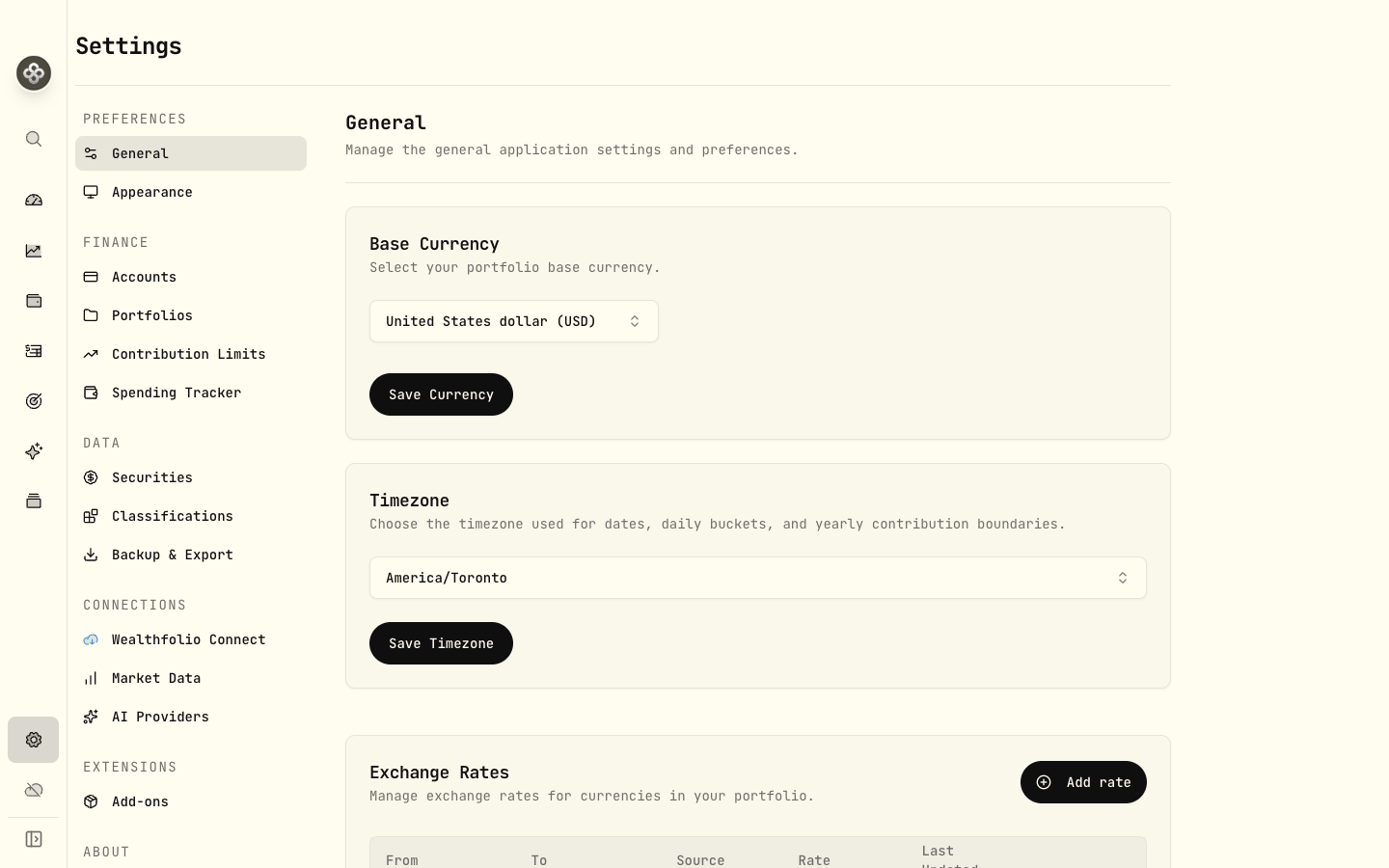
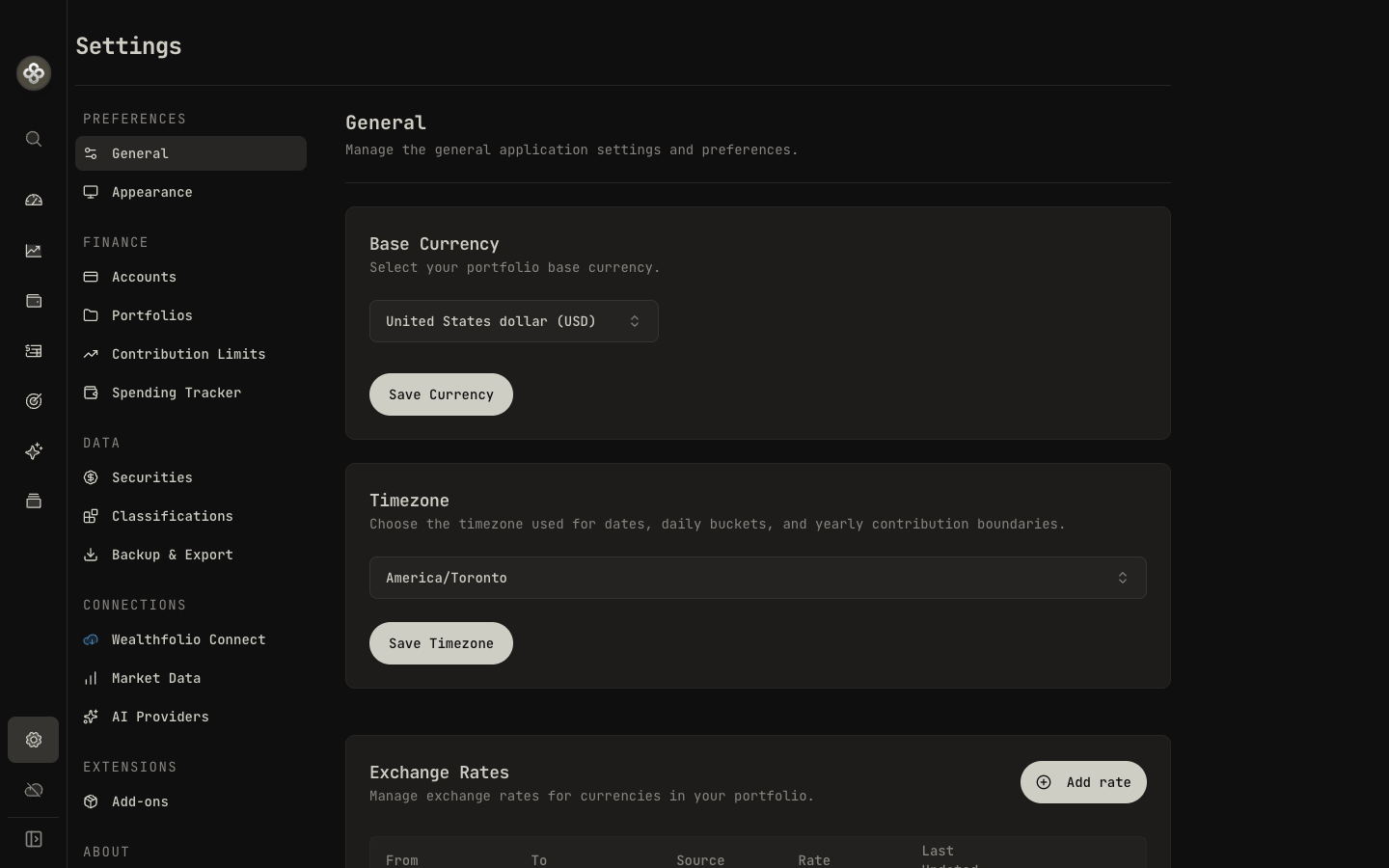
Open Settings from the bottom of the sidebar. Options are grouped into Preferences, Finance, Data, Connections, and Extensions, plus About.
Preferences
General
Base currency is the reporting currency for consolidated portfolio values. Changing it changes how those values are presented; it does not rewrite the currencies on your accounts, activities, or security quotes. Choose a currency and click Save currency. See Market Data & FX for how conversions work.
Language & region
These controls live on the General page and save when you change them:
- Language changes interface text independently of number and date formatting. Supported languages include English, French, German, Spanish, Brazilian Portuguese, Italian, Simplified Chinese, Traditional Chinese, Japanese, Korean, and Arabic.
- Region & formats controls date order, decimal separators, percentages, currency presentation, and 12- or 24-hour time. Choose System region, Canada, United States, United Kingdom, India, France, Germany, Austria, Switzerland, Spain, Mexico, Brazil, Portugal, China, Taiwan, Japan, South Korea, Italy, Romania, or Bulgaria. System region follows the locale reported by your browser or app environment, including regions without a dedicated option. Check the live date, number, currency, and time previews.
- Timezone controls local date and time display and date boundaries, including annual contribution periods. Select the timezone you want Wealthfolio to use.
Amount fields accept your region’s decimal separator. Changing the interface language alone does not change your financial formatting conventions.
Exchange rates
Review currency pairs, their rates, sources, and timestamps under General. To add a pair:
- Click Add rate and choose the From and To currencies.
- Choose a Source. For Manual, enter a rate greater than zero. For a market-data provider, Wealthfolio fetches the rate instead of asking you to enter it.
- Save the pair.
The direction matters: a rate of 1.35 from USD to CAD means USD 1 is CAD 1.35.
You can edit a manual rate in the table. Provider rates are refreshed through market-data
sync and cannot be edited inline. You can also delete a pair after confirming; if your
holdings or activities need it, you may need to recreate it for accurate calculations.
Wealthfolio handles currency variants such as pence and pounds (GBp and GBP) automatically.
You can’t add a pair in a quote unit such as GBp: the form asks you to enter the main
currency’s rate instead, for example GBP/USD.
A crypto pair such as BTC/USD added before 3.13 can keep failing to update from Yahoo. To fix
it, open the pair with the clock button in its row, choose Edit in the ⋮ menu, and on
the Market data tab set its Yahoo Symbol mapping to BTC-USD.
See Market Data & FX for conversion behavior and Market Data Providers for provider configuration.
Manual rates are not refreshed automatically. Review them periodically.
Automatic updates
Enable startup update checks for the desktop app. The switch saves immediately and controls checking for updates, not unattended installation. This section is hidden on mobile. Self-hosted deployments are updated through their hosting setup; see Self-hosting.
Appearance
Appearance is grouped into three cards. Changes save as you make them.
Theme shows eight themes: Classic, Signature, Ember, Cupertino, Newspaper, Cyber, Terminal, and Poster. Each is previewed as a small dashboard in your current mode. The Light, Dark, and System switch at the top of the card sets the mode; every theme has a light and a dark appearance.
- Picking a theme applies the font it suggests, if any, and never changes light or dark mode.
- Cyber and Terminal are made for dark mode. Pick one in light mode and you’re offered Switch to dark.
- The theme is saved on each device, so devices you sync can use different themes.
- New profiles start on Signature.
Text and numbers:
- Font family: Sans, Serif, or Mono. The row names the font your theme suggests, such as “Signature suggests Sans”. If you choose another, Use theme defaults goes back to the theme’s font.
- Text size: Small, Default, Large, or Extra large. It makes text and controls larger or smaller on this device. On iPhone and Android, the app starts from the system text size until you pick one.
- Gain and loss colors: Green up, red down (the default); Red up, green down; or Red up, blue down, for markets where red means a price went up. Gains, returns, day change, the treemap, and charts follow it; statuses, budgets, goals, and spending categories keep their own colours. It syncs across your devices; update them all to 3.12 or later before you change it, as a device on an older version misses the change.
Navigation (hidden on mobile):
- Sidebar or Floating bar: how you navigate on large screens.
- Show menu bar: show or hide the application menu bar. Only the Windows and Linux desktop app shows this switch.
Finance
Accounts
Add, edit, group, hide, or archive your accounts, and set tracking mode and currency. See the Accounts & Portfolios guide.
Portfolios
Build named reporting scopes across a set of accounts, then select them from the account picker anywhere in the app. See Accounts & Portfolios.
Contribution limits
Track contribution room for tax-advantaged accounts (IRA, 401(k), TFSA, RRSP…). See Contribution Limits.
Spending tracker
Opt accounts into spending, manage categorization rules, budgets, and life events. The Default monthly budget plan includes savings categories, each with a Savings goal. Deleting a category you’ve used merges it into another one, with its transactions, rules, and budgets. See Spending & Budgets.
Data
Securities
Review and manage the instruments in your portfolio, including their details and data settings. See Assets & Securities for the full guide.
Classifications
Edit the classifications (asset class, industry/sector, region, risk, and custom groups) that power Portfolio Insights and Allocation Targets. AI can help fill in missing tags. See Classify your assets for assignments, weights, and custom classifications.
Backup & export
Use the Backups tab to create, export, or restore a database backup, including an
unencrypted .db export. The Data export tab saves 23 datasets as CSV or JSON, one at a
time or all at once with Export all (a ZIP of CSV files, or one JSON file). Desktop and iOS
support restore in the app. Web mode lets you create, download, and delete server backups;
restoration requires stopping the server.
See Export & Backup for steps and platform differences.
Connections
Wealthfolio Connect
Connect a brokerage to import holdings and activities, or sync your data between devices. Device sync uses end-to-end encryption. See Connect & Broker Sync.
Market data
Built-in providers lists the providers that are on, in the order they’re tried: when more than one covers an asset, the higher one is tried first. Use the arrows beside a provider to move it, and its switch to turn it off; a move saves right away. Open a provider’s settings to enter an API key and review sync status or errors. Add provider lists the other built-in providers, with a search. AMFI (Indian mutual funds) and Moscow Exchange are off until you add them.
Custom providers have their own Custom providers card. You can also override the provider or symbol for an individual security. See Market Data Providers.
AI providers
Connect a hosted provider or local model, enable the providers and models available in the chat picker, and control each provider’s data access. Data access includes Spending, which lets the assistant read your spending reports, budgets, transactions, and events. It’s on by default; a selection you saved yourself before 3.13 doesn’t include it. Advanced options include custom endpoints and provider tuning. See AI provider settings for keys, model capabilities, and save behavior.
AI agent access
Start or stop the MCP server, configure auto-start and audit logging, and create or revoke scoped access tokens. Spending tools have their own permissions: View spending, Organize spending, and Manage budgets. Accounts — write lets an agent create and change accounts, and Holdings — write lets it save holdings snapshots and add alternative assets and liabilities. Choose Edit permissions on a token to change what it can do without creating a new one. After you add a write scope, reconnect the agent so it finds the new tools. Desktop and web controls differ; this entry is hidden in mobile Settings. See MCP Server.
Extensions
Add-ons
Install and manage community add-ons that extend Wealthfolio. See Add-ons.
About
Review the app version and project links. Desktop update controls let you check for a new release; update availability depends on your platform.