

MCP Server (Agent Access)
Expose your portfolio to external AI agents — Claude Desktop, Claude Code, Cursor, Windsurf, Cline, VS Code — over the Model Context Protocol, with scoped, revocable access tokens and a full audit log.
The MCP server lets external AI agents talk to your portfolio over the Model Context Protocol. Point Claude Desktop, Claude Code, Cursor, Windsurf, Cline, or any MCP-capable client at Wealthfolio and it can read your holdings, performance, and activities — and, if you allow it, draft or record new activities — through the exact same typed tools the built-in AI Assistant uses.
Every connection is authenticated with a scoped access token you create and can revoke. Nothing is exposed until you turn the server on and hand out a token.
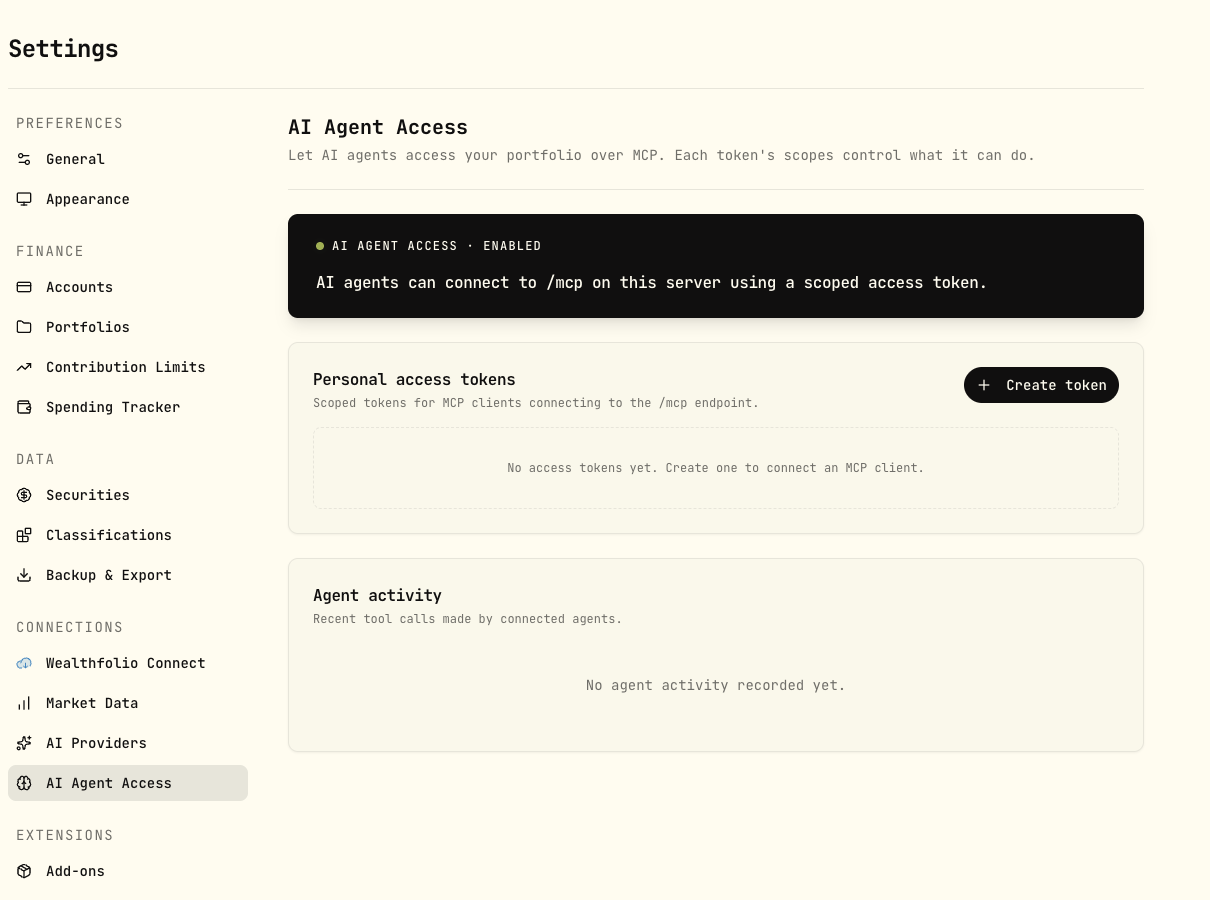
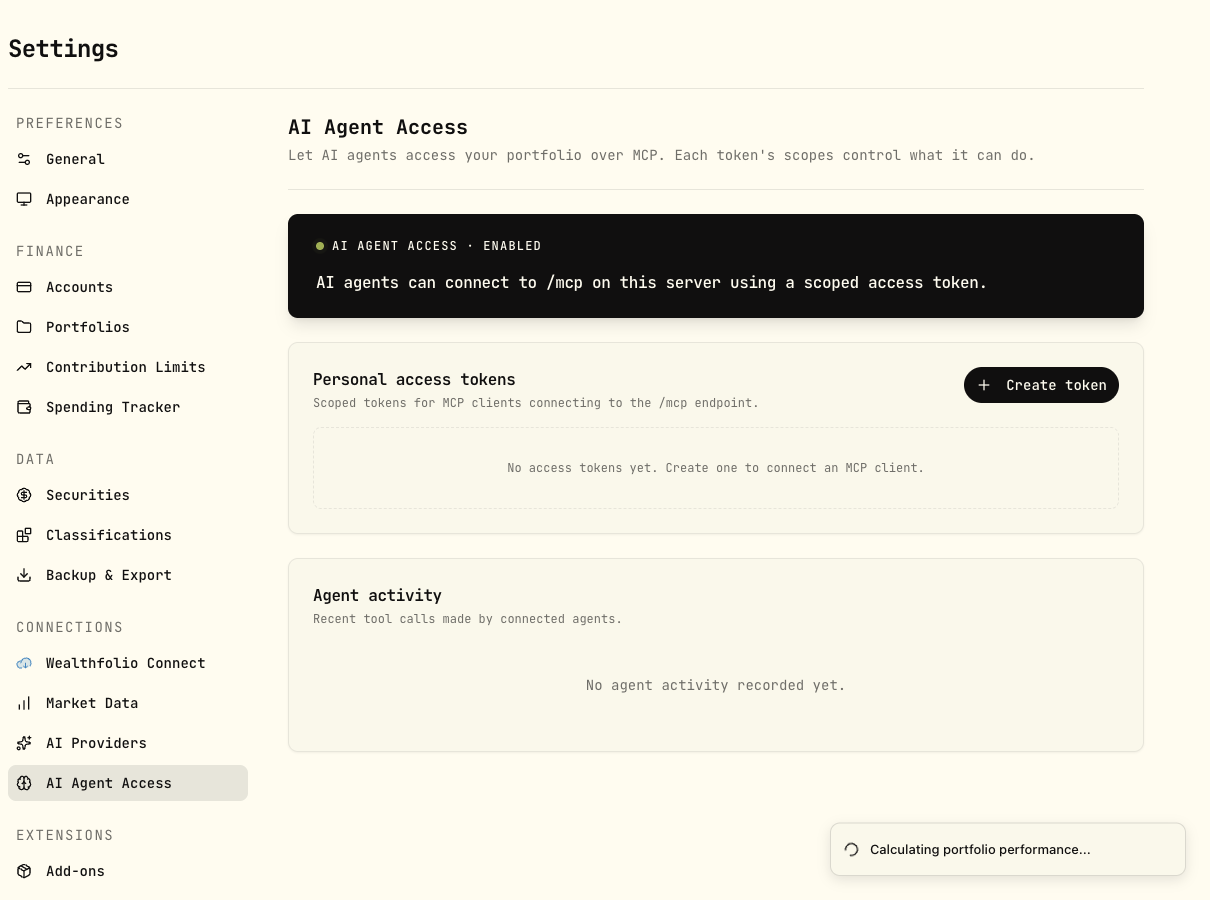
Assistant vs. MCP server. The AI Assistant is a chat window inside Wealthfolio. The MCP server is the reverse: it lets an agent running outside Wealthfolio (in your editor or desktop client) reach into your portfolio. Both run over the same local, typed tool registry — your raw database is never handed to a model.
1 · Where it lives
Open Settings → AI Agent Access. What you see depends on how you run Wealthfolio:
- Desktop app — a master toggle turns the feature on, then a local MCP server runs at
http://127.0.0.1:<port>/mcp. You control it with Start/Stop, choose whether it starts with the app, and toggle audit logging. - Self-hosted / web server — the endpoint is enabled with an environment variable
(see §6) and served at
/mcpon the same origin as your server. Token management and the audit log work the same way.
Agent Access is a desktop and web feature. It isn’t available on the mobile app.
2 · Turn it on and create a token
- Enable the server. Flip the master toggle (desktop) or set the environment variable (self-hosted). On desktop, press Start — the endpoint URL appears with a green dot when it’s live.
- Create an access token. Under Personal access tokens, click Create token, name it (e.g. “Claude Desktop”), pick an expiry, and choose its scopes. Tokens default to read-only — one click away from the common case.
- Copy the token once. It’s shown a single time at creation. The dialog also gives you a ready-to-paste client config with the token already embedded.
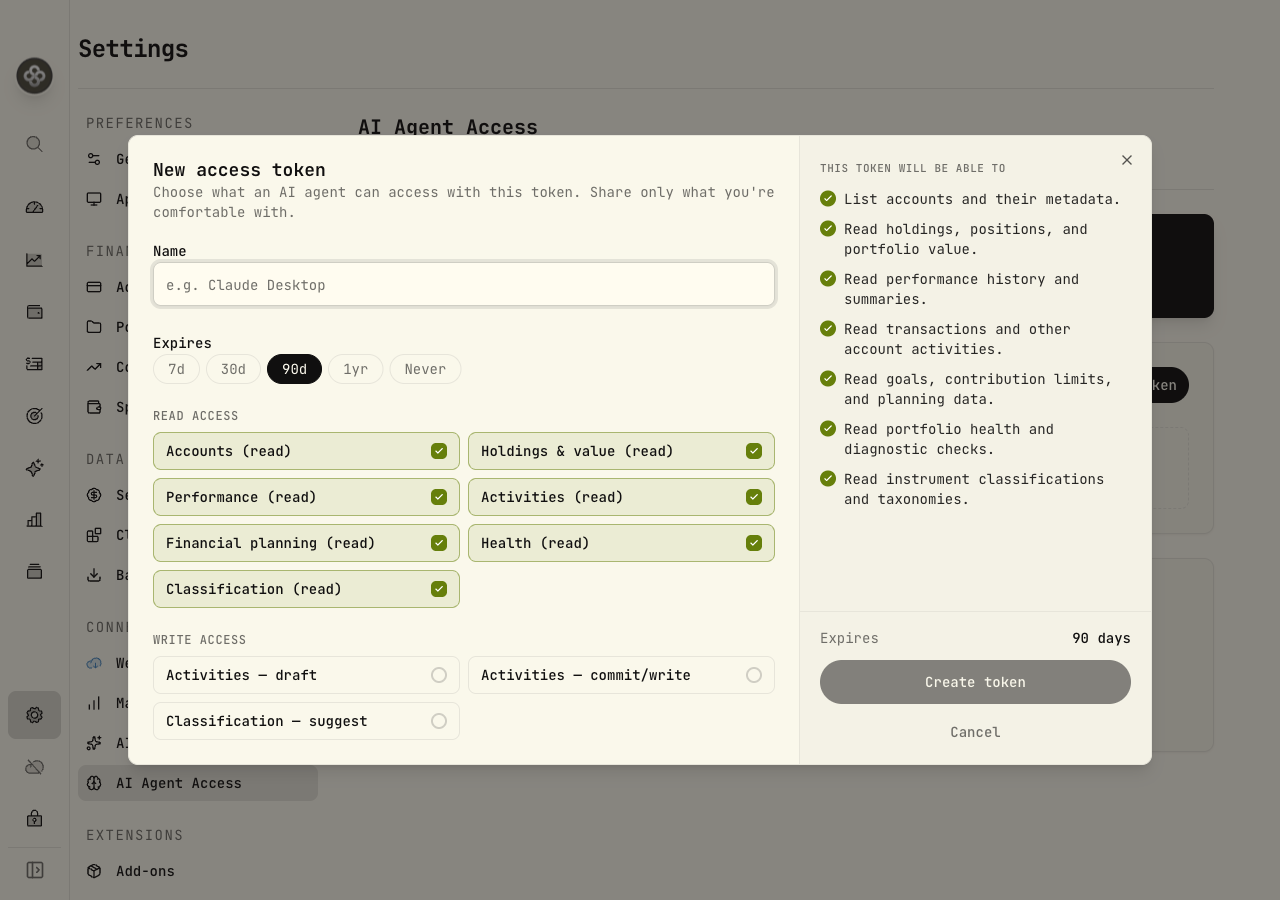
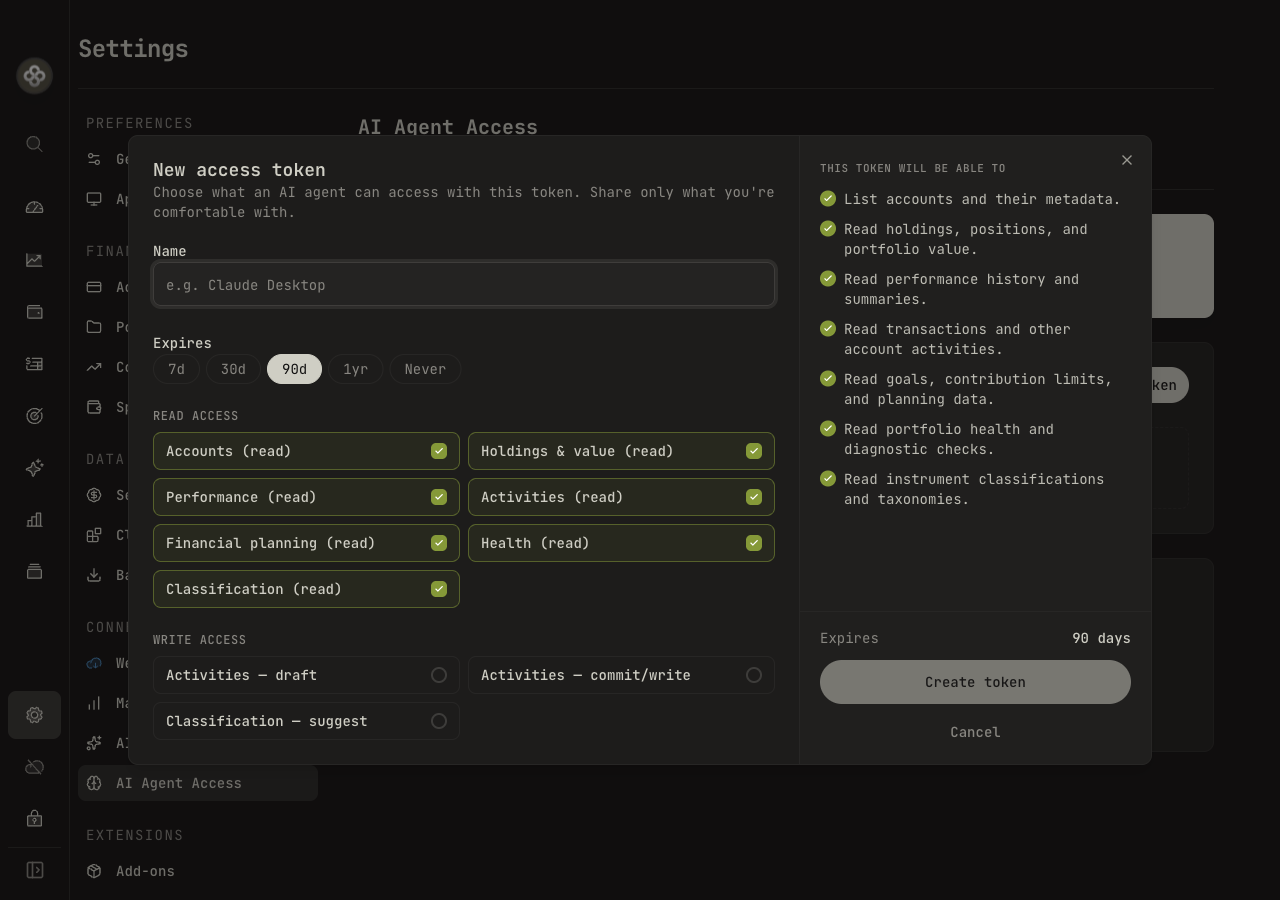
Expiry options are 7 days, 30 days, 90 days (default), 1 year, or no expiry. Shorter is safer — you can always mint a new one.
3 · Scopes — what a token can do
A token carries a set of scopes. The agent can only call tools its scopes allow; the backend rejects anything outside them. Scopes split into read and write.
Read access
| Scope | Grants |
|---|---|
| Accounts (read) | List accounts and their metadata. |
| Holdings & value (read) | Read holdings, positions, and portfolio value. |
| Performance (read) | Read performance history and summaries. |
| Activities (read) | Read transactions and other account activities. |
| Financial planning (read) | Read goals, contribution limits, and planning data. |
| Health (read) | Read portfolio health and diagnostic checks. |
| Classification (read) | Read instrument classifications and taxonomies. |
Write access
| Scope | Grants |
|---|---|
| Activities — draft | Prepare draft activities for review (nothing is committed). |
| Activities — commit/write | Commit activities. Requires the draft scope. |
| Classification — suggest | Suggest instrument classifications for review. |
The dialog offers four presets that cover most needs: Read-only, Read + draft,
Read + write, and Read + write + suggest. Activities — commit/write always
pulls in Activities — draft automatically — an agent has to be able to stage a change
before it can commit one.
Grant the narrowest scopes you’re comfortable with. A read-only token can never modify your data. Only add write scopes for agents you trust to record or draft activities, and prefer a short expiry for those.
4 · Connect a client
Wealthfolio speaks Streamable HTTP MCP. Most clients (Claude Desktop, Claude Code,
Cursor, Windsurf, Cline) share the same config shape — the Copy config button on the
server card produces exactly this, with YOUR_TOKEN as a placeholder:
{
  "mcpServers": {
    "wealthfolio": {
      "type": "http",
      "url": "http://127.0.0.1:PORT/mcp",
      "headers": { "Authorization": "Bearer YOUR_TOKEN" }
    }
  }
}
Replace PORT with the port shown on the server card (self-hosted users use their
server’s URL) and YOUR_TOKEN with the token you copied.
VS Code differs — it uses a top-level servers key:
{
  "servers": {
    "wealthfolio": {
      "type": "http",
      "url": "http://127.0.0.1:PORT/mcp",
      "headers": { "Authorization": "Bearer YOUR_TOKEN" }
    }
  }
}
Any other client that speaks Streamable HTTP just needs the URL plus an
Authorization: Bearer YOUR_TOKEN header.
Where the config goes
| Client | Config location |
|---|---|
| Claude Desktop | Settings → Developer → Edit Config (claude_desktop_config.json) |
| Claude Code | .mcp.json in your project root |
| Cursor | ~/.cursor/mcp.json (or .cursor/mcp.json in a project) |
| VS Code | .vscode/mcp.json |
| Windsurf | ~/.codeium/windsurf/mcp_config.json |
| Cline | Cline → MCP Servers → Configure (cline_mcp_settings.json) |
| Jan | Settings → MCP Servers → Add |
Once connected, the agent discovers Wealthfolio’s tools automatically. Ask it “what are my top holdings?” or “how did my portfolio do this year?” and it’ll call the read tools and answer with your real numbers.
5 · Audit log
Every tool call an agent makes is recorded under Agent activity — the time, the tool name, the outcome (Success, Denied, or Error), and which token made the call. Filter by tool or outcome, search, and Clear log when you want a clean slate.
On desktop, the Log agent activity switch turns recording on or off. On a self-hosted server it’s controlled by an environment variable (below). With logging off, no new audit rows are written.
6 · Self-hosted servers
On a self-hosted Wealthfolio server the MCP endpoint is off by default and enabled with environment variables:
| Variable | Effect |
|---|---|
WF_MCP_ENABLED=true | Serves the MCP endpoint at /mcp. Restart the server after setting it. |
WF_MCP_AUDIT_ENABLED | Set to false to stop writing audit rows. |
After enabling, create tokens from Settings → AI Agent Access exactly as on desktop.
The url in your client config is your server’s origin plus /mcp (for example
https://wealth.example.com/mcp).
Self-hosted MCP requires Wealthfolio auth. On Docker, Unraid, and other
network-accessible server installs, WF_MCP_ENABLED=true requires Wealthfolio’s own
authentication to be configured with WF_AUTH_PASSWORD_HASH or OIDC. If you run the
app with WF_AUTH_REQUIRED=false because a reverse proxy handles login, the server
will refuse to start with MCP enabled.
You can still keep your reverse proxy in front, but leave Wealthfolio auth enabled too. MCP tokens are created through the app’s Agent Access API; reverse-proxy-only auth cannot currently replace that app-level protection.
A self-hosted MCP endpoint is reachable by anything that can hit your server. Put it behind your usual auth/reverse proxy, keep tokens scoped and short-lived, and remove tokens you no longer use.
7 · Security model
- Nothing is exposed by default. The server is off until you enable it, and it serves nothing without a valid token.
- Local-only on desktop. The desktop server binds to
127.0.0.1— it isn’t reachable from other machines on your network. - Scoped and revocable. Each token carries only the scopes you granted. Remove a token and any client using it loses access immediately.
- Writes are gated. Committing an activity requires both the draft and write scopes; a draft-only token can stage changes but never commit them.
- Stopping ≠ revoking. Stopping the server (or disabling the feature on desktop) keeps your tokens valid — they resume working when you start it again. To cut a client off for good, delete its token.
- Typed tools, not raw SQL. Agents call the same scoped, typed tools as the AI Assistant. They never receive your database or your other API keys.
8 · Troubleshooting
The client can’t connect
- Make sure the server is running (green dot on the server card, or
WF_MCP_ENABLED=trueand a restart on self-hosted). - Check the
urlandPORTmatch what’s on the server card, and that the path ends in/mcp. - Confirm the
Authorizationheader isBearer <token>with a valid, unexpired token.
The container won’t start after setting WF_MCP_ENABLED=true
On self-hosted installs that bind to the network, MCP requires Wealthfolio auth. If you
set WF_AUTH_REQUIRED=false and rely only on a reverse proxy for login, the server
refuses to start because the Agent Access API can mint long-lived MCP tokens.
Fix it by configuring WF_AUTH_PASSWORD_HASH or OIDC, then restart with
WF_MCP_ENABLED=true. If you don’t want Wealthfolio auth enabled, leave
WF_MCP_ENABLED=false.
The agent says a tool was “denied”
The token is missing the scope for that tool. Create a new token with the scope you need (or the right preset) — scopes can’t be edited after creation, so mint a fresh one and remove the old.
It worked yesterday, not today
Check whether the token expired (see its status in the token list) or was removed. On desktop, also confirm the server is started and, if you rely on it, that auto-start is on.
Next step: If you’d rather chat with your portfolio from inside the app instead of wiring up an external agent, see the AI Assistant.